
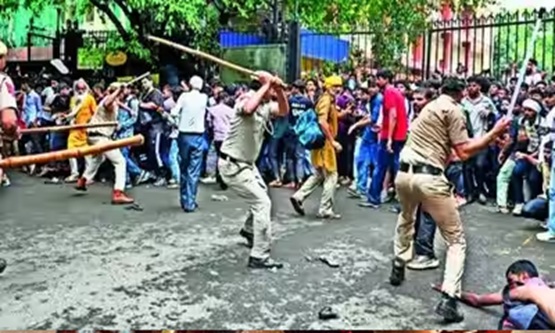
Police action during Delhi protest sparks row in parliamentary panel

A meeting of the Parliamentary Standing Committee on Home Affairs witnessed a heated confrontation on Tuesday after Opposition members sought a discussion on alleged police excesses during a July 20 protest in Delhi.
The committee, chaired by BJP MP Radha Mohan Das Agarwal, was scheduled to discuss crime against children, with officials from four ministries attending.
Soon after the meeting began, Congress leader and Rajya Sabha MP Ajay Maken referred to a letter he had sent to the chairperson. He requested that the scheduled agenda be set aside so the committee could discuss allegations concerning the Delhi Police’s handling of the youth-led demonstrations at Jantar Mantar.
Maken alleged that police personnel used pellet guns, lathis and barricades that protesters claimed could deliver electric shocks. He also alleged that a truck carrying stones had been positioned near the protest site in an attempt to implicate demonstrators.
He further claimed that some police personnel were without name tags and that people in civilian clothing were involved in using lathis against protesters.
Agarwal declined to take up the matter, citing its sub judice status. He pointed to Supreme Court directions and noted that a panel appointed by the apex court was already examining the allegations.
Opposition members, including Congress MP Priyanka Gandhi Vadra, TMC leader Derek O’Brien, Shiv Sena (UBT) leader Sanjay Raut and NCP (SP) MP Supriya Sule, objected to the decision. They argued that the allegations were of sufficient public importance to warrant discussion.
The disagreement soon developed into a wider political confrontation. BJP MP Tarun Chugh referred to the 1984 anti-Sikh riots and questioned whether allegations of police excesses from that period had received adequate investigation.
Congress member Jai Prakash responded by arguing that alleged fake encounters during BJP-led governments, including in Haryana, should also be examined if the committee intended to discuss police-related issues.
The exchange became heated enough for the chairperson to intervene. Agarwal subsequently suggested that the panel could consider discussing a standard operating procedure for police action during protests at a later stage. Opposition members accepted the proposal, bringing the immediate confrontation to an end.