
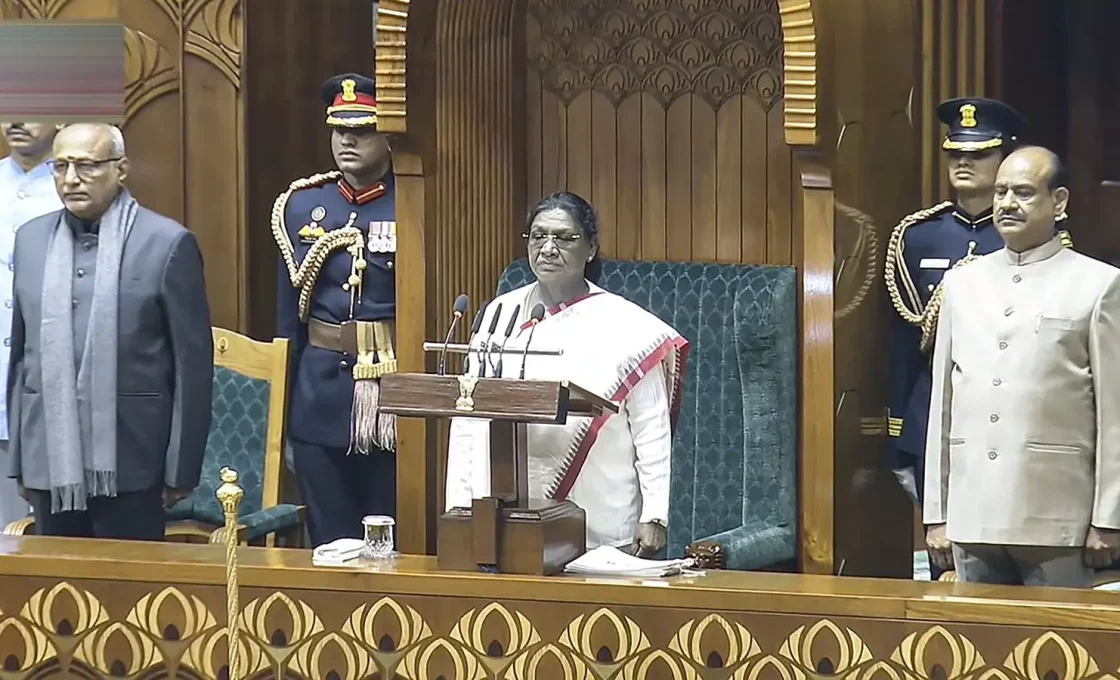
Parliament’s Budget Session begins with President’s speech

The Budget Session of Parliament began with the ceremonial address of President Droupadi Murmu to the joint sitting of both Houses.
Speaking on the occasion, President Murmu highlighted the Central government’s sustained focus on strengthening the country’s public healthcare system, describing health and well-being as a central pillar of inclusive national development.
The President outlined the government’s vision of “Sabka Saath, Sabka Vikas”, placing accessible, affordable and quality healthcare at the heart of human capital development, with special emphasis on the poor, vulnerable and underserved sections of society.
Highlighting the impact of flagship initiatives of the Ministry of Health and Family Welfare, the President noted that over 11 crore people have received free medical treatment under the Ayushman Bharat Pradhan Mantri Jan Arogya Yojana (PM-JAY) since the launch of the scheme.
In the past year alone, nearly 2.5 crore poor and vulnerable citizens benefited from free treatment under government health schemes, significantly reducing out-of-pocket healthcare expenses.
Special initiatives for senior citizens were also highlighted. According to the President, nearly one crore Ayushman Vay Vandana Cards have been issued over the past one and a half years, enabling about eight lakh elderly citizens to access free healthcare services.
Emphasising the strengthening of primary healthcare, President Murmu said that 1.80 lakh Ayushman Arogya Mandirs are now operational across the country.
These centres are playing a critical role in delivering comprehensive primary healthcare services, particularly in rural, remote and underserved areas.
The address also drew attention to the government’s mission-mode approach to disease prevention and public health management. Under the National Sickle Cell Anaemia Elimination Mission, more than 6.5 crore people – especially in tribal, rural and remote regions – have been screened, enabling early diagnosis and prevention.
Sustained public health interventions have also led to effective control of Japanese Encephalitis and related diseases, particularly in endemic districts of Uttar Pradesh.