

Gold Derivatives Can Strengthen India’s Financial Markets and Price Discovery

India’s gold market is moving from physical ownership towards a more financialised market, with derivatives giving participants greater ability to discover prices, manage risk and participate in organised markets. Gold has evolved from a store of wealth into a financial asset accessed through ETFs, digital gold, collateral and derivatives. The report Gold Derivatives – Deepening the Market and the Road Ahead in India identifies gold derivatives as an important force in this transition, broadening access to organised markets beyond traditional bullion dealers to investors, jewellers, refiners, importers and financial institutions.
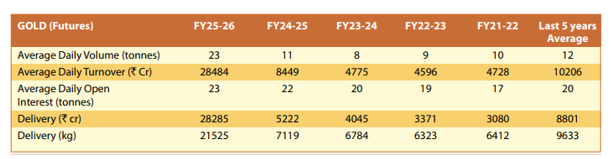
India’s gold derivatives market has been one of the strongest examples of how financial instruments can drive long-term transformation while creating benefits for investors and the wider gold ecosystem. Since the introduction of gold derivatives in 2003, the market has grown significantly, with average daily turnover exceeding ₹2.2 lakh crore and average daily open interest standing at 43 tonnes, reflecting sustained participation and long-term interest in the market. Around 175 tonnes of gold have also been physically delivered through the exchange mechanism since inception. This physical delivery demonstrates the confidence of market participants in the robustness and efficiency of the organised market mechanism and highlights how derivatives can create a stronger connection between financial markets and the physical gold ecosystem.
Table 1: Recent Trade Performance of Gold Futures
The evolution of gold derivatives also reflects a broader opportunity for India’s commodity markets: to build stronger domestic price references, enable businesses to hedge price risk within India, create investment avenues and develop a deeper risk-management ecosystem across commodities. Price discovery is one of the most important roles of commodity derivatives. Exchange-traded futures and options can provide transparent and efficient price references for market participants, helping businesses make decisions around inventory, production, procurement, storage and marketing.
Bullion provides the strongest example of this opportunity, with MCX prices increasingly being used as an India price reference by market participants. The report also highlights the potential for Indian gold futures to play an even greater role in domestic and regional price discovery. Given India’s established gold trade links with South Asia and the Gulf region, Indian gold futures have the potential to contribute more significantly to regional price discovery. As
participation and liquidity deepen across bullion, metals, energy and agri commodities, there is an opportunity for India-specific price references to become increasingly relevant to domestic businesses and market participants.
The second important role of derivatives is risk management. Commodity prices can have a direct impact on the costs, margins and cash flows of businesses across the value chain. Effective hedging mechanisms allow participants to manage this exposure rather than remain fully dependent on movements in physical market prices. In gold, exchange-traded derivatives can help importers, bullion traders, jewellers and refiners manage exposure to price volatility. The report highlights inventory hedging as an important application of gold derivatives, helping businesses bring greater certainty to cash flows and make better decisions around inventory, production, storage and marketing. As mentioned in the report, “Gold derivatives facilitate inventory hedging and promote efficient supply chain management, which reduces costs and enhances operational resilience.”
This creates an opportunity for more Indian businesses to manage their commodity price risk within India. Across bullion, metals, energy and agri commodities, deeper and more efficient derivatives markets can provide businesses with effective tools to manage price volatility, improve planning and strengthen operational resilience.
Commodity derivatives also provide investors with an avenue to participate in commodity markets without requiring physical ownership. This can broaden participation beyond traditional commodity businesses and allow investors to use commodities for portfolio diversification. The report notes that greater institutional participation can bring additional liquidity and depth to the market. Exchange-traded commodity derivatives can therefore support the development of Indian commodity markets not only as risk-management platforms but also as transparent and efficient avenues for investment and participation.
Bullion remains the strongest anchor for this broader commodity-market story because gold represents one of India’s most established and developed commodity markets. The development of India Good Delivery standards through MCX and the recognition of domestic refiners are important steps towards building market infrastructure and standards that are relevant to Indian participants. These developments strengthen the connection between domestic refining, physical gold and organised commodity markets, while providing a foundation that can inform the development of other commodity markets.
The broader opportunity is to build on this experience across metals, energy and agri commodities. In metals, Indian price references can become increasingly relevant to traders, SMEs and industry as participation and liquidity develop. In energy, oil and natural gas offer opportunities to deepen liquidity and strengthen domestic mechanisms for managing commodity price risk. In agri commodities, which remain highly important to local producers and businesses, effective price discovery and hedging can provide significant value.
For India, the development of gold derivatives is therefore not only about creating instruments to manage movements in the price of gold. It is about building stronger connections between the physical commodity economy, financial markets and the wider commodity ecosystem. The larger opportunity is for India to increasingly Price in India, Hedge in India, Invest in India and Manage Risk in India.
Gold provides the strongest proof point for this evolution. The scale of participation, open interest and physical delivery demonstrates how an organised derivatives market can connect financial instruments with the underlying physical ecosystem. The next phase is to build on this foundation across metals, energy and agri commodities through deeper liquidity, wider participation, stronger market infrastructure and continued development of India-specific price references. Continued regulatory support, innovation and broader participation will be important to realising this potential and creating a more integrated, efficient and resilient commodity market ecosystem for India.
Rupee Prices strengthen India’s Base Metal Price Discovery
Base metals such as aluminium, copper zinc are a critical part of India’s economic growth story. A new report says the derivatives market built on these metals is an important part of the same story.
The report, ‘Base Metals: Laying the Foundation of India’s Economic Growth’, released by the Multi Commodity Exchange of India (MCX) at the Global Commodity Conference, states rupee-denominated prices on India’s commodity derivatives market are used by smelters, fabricators, traders, and manufacturers to price physical transactions, hedge exposure, and plan production.
The rupee-denominated, exchange-discovered price referred to in industry parlance as ‘MCX Price’ is becoming the reference point for aluminium, copper, lead, zinc and nickel across the Indian value chain. Unlike some international reference prices, which reflect international fundamentals and exchange rate movements, MCX prices better reflect Indian demand-supply dynamics, duty structures, and logistics costs, making them relevant benchmarks for domestic contracts, tenders, and internal pricing formulas used by smelters, fabricators, and traders. It makes the prices a relevant benchmark for local contracts, tenders, and internal pricing formulas.
Use of domestic exchange-discovered commodity prices as reference
India’s commodity derivatives market, including the base metals segment, is one of the fastest-growing in global commodities. Indian entities with exposure to base metals have prices reflecting Indian market fundamentals. These INR-denominated prices should also be used as the reference in fixing customs duties, export incentives and other policy mechanisms. This, the report argues, will give India a credible, self-sufficient reference point and reduce the need to anchor Indian trade and procurement decisions to international prices.
If government departments and Central Public Sector Enterprises (CPSEs) take the lead, corporate India will follow. This will promote the indigenisation of commodity prices and encourage users to rely on Indian prices.
The market has become deeper since metal contracts moved to compulsory delivery in 2019. Liquidity in copper and zinc derivatives has averaged about two and a half times stakeholders’ exposure in these metals. The report states that close to six lakh tonnes of metal have been delivered through these warehouses since 2019, including during the pandemic lockdowns, when much of the physical market shut down but exchange trading continued without interruption.
It calls for hedging in INR-denominated derivative instruments to encourage those looking to hedge abroad. It will also help save forex outflows. RBI guidelines for hedging in international
markets exclude gold from commodities whose price risk can be hedged overseas. This, the report says, means interest in gold hedging has seen an uptick in increased open interest in gold derivatives on domestic exchanges. The increase in domestic hedging, in turn, has supported the bullion economy in India.
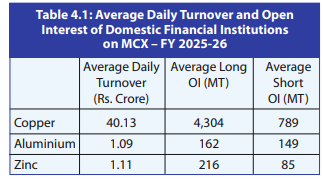
It estimates companies hedging domestically can save about 1.5 and 2% of contract value in currency conversion and clearing costs. According to the report, for domestic investors, there are no options to hold aluminium, copper, lead, nickel, or zinc as a financial asset. This means derivatives emerged as the primary route to the asset class. Moreover, these instruments are not tied to equities and instead move with the US Dollar Index. This, the report argues, helps base metals derivatives diversify an investment portfolio. Contracts come in different sizes, which means the market is open to large corporate treasuries, smaller hedgers and individual investors.
Room for further development
The report argues that the market remains well below its potential, and closing the gap will require policy shifts. This includes linking customs duties, export incentives, and government procurement to domestic rupee prices instead of international prices. It also calls for getting more investors into the market, since presently Foreign Portfolio Investors, banks, insurers, and pension funds cannot participate. It also calls for tweaking GST norms to encourage metal trade across states and letting banks lend against metal stored in approved warehouses, to make sure stored metal can be used as security for a loan.
The industry calls for more investors into the market, since presently Foreign Portfolio investors (FPIs), banks, insurers, and pension funds cannot participate. It also calls for letting banks lend against metal stored in approved warehouses, to make sure stored metal can be used as security for a loan.
The way forward is clear. India’s industrial and infrastructure sectors are expanding, and its markets are growing, along with the wider domestic economy. Base metal derivatives are between these developments, linking industry with investment, growth with stability. With greater institutional participation and supportive policy actions, base metal derivatives can become one of the most dynamic pillars of India’s financial system.
India’s Agri Growth Drives Demand for Price Risk Management
India’s shift towards higher-value crops is creating greater demand for organised price discovery and risk management, with spices and oilseeds emerging as key drivers of agricultural growth.
The findings are from the MCX report, “Harvesting Value: India’s Agricultural Commodity Markets,” launched through Global Commodity Conclave (GCC). The report examines the changing composition of India’s agricultural economy and the role of derivatives in supporting farmers, processors, traders and exporters.
Spices and oilseeds lead agricultural growth
Spices recorded the strongest production growth among the crop categories covered in the report. Production rose from 6.99 million metric tonnes (MMT) in 2015-16 to 12.99 MMT in 2024-25, an increase of 85.9%. Production is projected to touch 18.12 MMT by 2029-30, growing at a forecast CAGR of 6.87%.
High value spice has seen growth across the board. The production of Ajwain has increased more than 3 times during 2015-16 and 2024-25. Ginger has registered a CAGR of 9.12%, cumin 8.75% and garlic 8.23%.
Oilseeds have also grown strongly. 25.25 MMT in 2015-16 increased to 42.99 MMT in 2024-25 showing cumulative growth of 70.2%. The segment grew at a CAGR of 5.46%, the second highest growth rate among the eight segments analysed. Oilseed production is projected to touch around 56.7 MMT by 2029-30.
Among major oilseeds, rapeseed and mustard led the growth with production rising 86.4% to 12.67 MMT. Soybean and groundnut production increased 78.2% and 77.4%, respectively. Together, groundnut, rapeseed and mustard, and soybean accounted for 95% of the oilseed sector’s INR 2,135.3 billion economic output in 2023-24.
The report notes that India’s agricultural growth is increasingly being driven by “high-value commodities, such as spices and oilseeds”, creating opportunities for market-based risk management, value addition and organised trading.
Derivatives can strengthen price discovery
The changing crop mix is increasing the importance of efficient market mechanisms as production, consumption and trade expand. The report describes a well-functioning agricultural derivatives market as an “essential component of agricultural market infrastructure”, supporting price discovery, risk management, market transparency and economic development.
Futures markets bring together information from producers, processors, traders and investors to generate transparent, forward-looking price signals. The signals can aid
decisions regarding production, procurement, storage and marketing. Hedging is a useful tool for participants to deal with price volatility as well as income uncertainty.
The report notes that futures prices lead spot prices for many Indian agricultural commodities, making them useful reference points for physical transactions. These forward-looking price signals can also help market participants decide whether to sell immediately or hold produce for later sale.
The report also emphasises the role of digital warehousing and electronic warehouse receipts in linking physical commodities to finance. By linking warehousing, financing, physical trade and futures markets, the system can improve transparency and support more effective price discovery and risk management across the agricultural value chain.
Significant room for expansion
India’s agricultural derivatives ecosystem has substantial scope to broaden alongside the growth in commercially important crops. Of the 117 major agricultural commodities identified under the Ministry of Agriculture’s classification, 11, or about 9%, currently have active exchange-traded derivative contracts.
MCX’s agricultural portfolio includes Cardamom, Cotton, Cotton Seed Wash Oil, Kapas and Mentha Oil, covering products across spices, fibre, raw cotton and oilseed-linked categories.
MCX announced introduction of futures contracts on Crude Sunflower Oil, expanding exchange-traded risk-management avenues for participants across India’s edible oil value chain. This move will further strengthen price discovery and risk management across India’s edible oil market.
The report notes that expanding commodity coverage, digital warehousing, improved physical market infrastructure, greater institutional participation and consistent regulatory support are areas that can help deepen the agricultural derivatives ecosystem. Reforms such as reclassifying commodities, raising position limits at the client level, phasing in physical settlement and broadening participation by financial institutions could improve liquidity and hedging efficiency.
The opportunity extends beyond derivatives trading. A stronger agricultural market infrastructure can connect price discovery, risk management, warehousing, financing and physical trade, supporting more efficient supply chains, access to working capital and greater income resilience.
As the report puts it, a vibrant agricultural derivatives market can function as “connective economic infrastructure”, with the potential to support deeper financial market participation, more resilient rural incomes and a stronger position for India in global commodity markets.
1_GOLD DERIVATIVES – DEEPENING THE MARKET AND THE ROAD AHEAD IN INDIA
Base Metals Laying the foundation of India’s economic growth